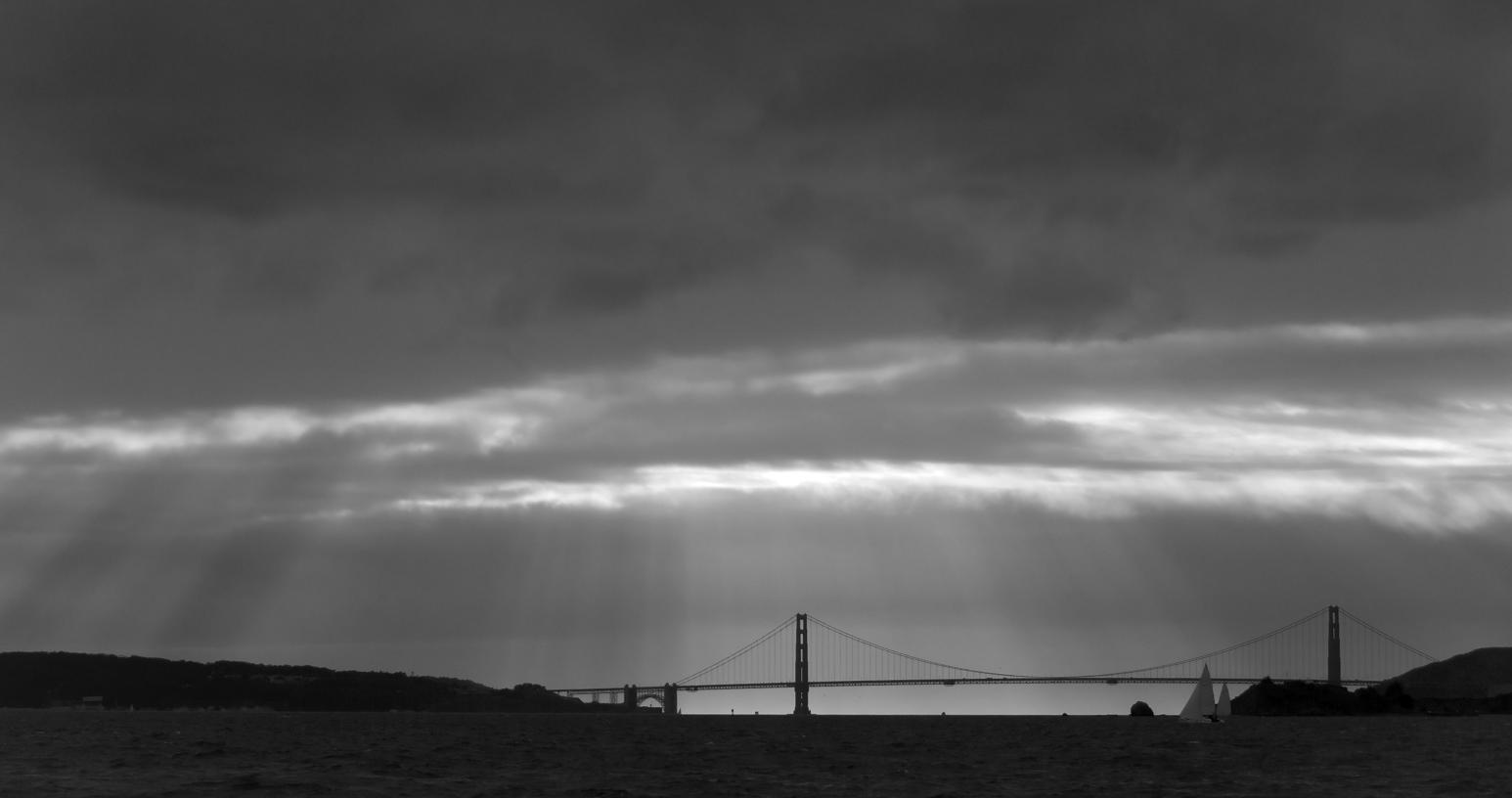
Friday, December 21, 2007

Elise December Cruise - preparation

Christmas frog traveled with us.
Lunch on deck prior to departure.

I like to take my winter vacation when there's no one else around. That way, you can feel like you're sailing on virgin ground 20 minutes away from the Club. The vacation started with a nice Christmas Gospel concert at the Symphony and put us into a very festive mood. The next day brought us back on Earth as we prepared food, clothing, gear and planned the trip after looking at the weather forecast. The first couple of days were supposed to be blessed by 10-20 knot winds so we decided that we should head out to take advantage of the breeze!

Finally, on the Monday morning, we were ready to leave. As you can see below, we travel light.


Really, not much. France is nicely packed, offshore flares, food and drinks, lifesling and MOB pole, our sailing gear, sleeping bags, books, magazines, camera, baby wipes. The strict minimum.

We needed to set up a couple of extra pieces on the boat to make it offshore ready. We take it out when we race around the Bay because it's heaaaaaaaaaaaaaaaavy.
1) flares, drogue, emergency navigation lights, harnesses and tethers etc...are all required
2) jack lines around the boat so we can clip ourselves onto something solid at night or if things get a little rough. That way, if we do go overboard, we most likely only break a few ribs and dislocate our shoulder.
3) lifesling + strobe + MOB pole all attached and ready to be thrown into the water if the jack lines don't do their job
4) extra gas...it's wintertime and it could get very light so we took three full gas cans with us
5) a lot more food and water, just in case, even though we were planning on breakfast and dinner ashore
6) up-to-date charts + GPS

We also took out our racing sails and replaced them with our cruising sails (and our nice new #3 jib).

I wanted to spend this time, the planning, provisioning, setting up of the boat (we did re-seal the end of the shrouds, check the battery, etc...) are helpful. Nathan had gone offshore on Elise already but I missed all these opportunities over the past year. Before I go on the Pac Cup, I want to know every inch of the boat. In an emergency, I don't want to have to use the GPS to locate the flares or run out of food in the middle of the Pacific - and I would like to select the wine. It forced us to plan around the weather forecast, use this knowledge to determine our sail inventory, etc...

There is only one way to get to know Elise - it is to spend a lot of time with her. On deck and sail-related activities are only one aspect of long-distance sailing. We also need to arrange for as comfortable as possible a hotel, and a safe haven.

As I lovingly dressed up Elise, the wind gently invited us out for a magic evening sail.

Private Lounge

Something is wrong with this picture. Something's missing. Can you guess what it is?
No? OK, let's get closer. And now?
The wine!!!! But of course!

Great Pumpkin

There was so much wind on that day (so much that the race got cancelled) that crew must hang on tight in order not to fall overboard.
Nick: "When I went to Tahoe, I fished a trout this big"
Parking lot
Train and Good Samaritan Elise.
The committee boat is skillfully navigating between boats.
Impressive. A spinnaker up in this much wind.
Nat eating (we needed a lot of energy to fight the rough weather conditions) and checking out competition. Always good to check what other women are wearing, they may have some good ideas.
Escapade not escaping the parking lot black hole.

No second thought about double-handling

After a week's cruise on Elise, I think that I may be a little tired. Wet gear, food that doesn't taste quite like food, a bottle of wine that's half empty but plenty of toilet paper left. Or should I say "bucket paper"?

I guess that I was a little "ripe" too, despite my best efforts with baby wipes, onshore facilities, etc...For the first time in my life someone said to me "you need a shower" and meant it.
I also need a hot drink and real nice porcelain throne...

Remember, Elise has no running water, no proper galley, no heating, no stove, no table (we used the cooler), no standing headroom - not even for me. It doesn't sound too luxurious and yet I had a fabulous time. All of this may have gotten in the way of this test of character and since there wasn't much else to do, we ended up sailing :)

There may be two of us on board but doublehanded racing is taking turns at singlehanded racing. With some exceptions, we will be alone on deck while the other will try to get some sleep, eyes closed, bundled below on the quarter-berth and listening to the gentle drip of water through the cabin top slider, or the waves crashing against the hull. There is nowhere to hide and nowhere to go. We each need to do our share of the work and do everything - we are both tacticians, bowman, driver, navigator, trimmer and rail meat. Our combined skills will hopefully build up to a full complement of crew.

And knowing that there is someone else on board is very reassuring...

With some much to do and with responsibilities spread across two individuals, we have to accept that the boat will not go as fast as it can when it is fully crewed. Our reaction times are delayed, weight doesn't balance the boat well and may even force us to reduce sail area way before we would think of doing so with a full crew. Manoeuvres are slower as some of the things that can happen in parallel with a full crew need to happen sequentially.

Having said this, I believe that short-handed sailing makes you a better sailor faster. Each outing teaches you something new that you will have to deal with as no one else is around to help. And it's a lot of fun.

Above or below, there is no privacy. The majestic bucket sits facing the companionway :) The only way we can get some privacy is by splitting up, one person above deck and one person below deck with a closed companionway hatch. This may have some drawback as above deck it could be cold and wet and below deck at times, it might be a bit harsh on your stomach.

Still - I wouldn't have given up this experience for anything in the world. More detail to follow on our little adventure.

Midwinters Photos - Courtesy of Dayne

Chinese theater: a genoa works very well as a screen for some shadow-based story-telling. Since most boats are not going at some hat-loss-under-you-have-attached-it prone speed, there's plenty of time to enjoy the show.
Nathan looking at the gate thinking "It's big"
Heather and Amy looking at the gate thinking "It's beautiful"
No comment.


This could just about work as the Blue White and Red flag...
"If you're going to San Francisco, remember to put spinnakers in your hair..."


Amy: "we need to tack, this side is really bad for my tan"
Nathan, checking the taktik "Ooo, that's beer speed"
Heather: "do I really want to go scuba dive in Antartica? Pretty cold here too"
Barbie and Ken's boat

Happy Sailing Greetings


Dear, Chers, Queridos Beethovens

Thank you for your support throughout 2007 - I wish you all a wonderful Holiday season and a very happy New Year!
Merci pour votre support tout au long de 2007 - je vous souhaite d'excellentes fetes de fin d'annee et une tres bonne nouvelle annee!
Gracias por su apoyo durante 2007 - muy felices Fiestas y un prospero Ano Nuevo!

Pacific Cup DH Elise Crew (and substitutes)


Sunday, December 16, 2007

The first Berkeley Midwinter race this year (Nov) had been canceled after the Busan oil spill. For December 8, we were looking at a good-sized fleet of Express 27's (14, with our own start). In attendance were Nat, Nathan, Heather (bow), Dayne (trim), and Amy (trim).

The Berkeley Circle venue includes a start/finish mark in the center and eight turning marks evenly spaced around it (the center being designated "X" and the surrounding marks "A" through "H").

This month, the course was a twice-around windward-leeward. The wind was very light in the morning, and we needed to motor over, but it picked up enough by start time to avoid a postponement. We flew the #1 for all upwinds.

Our start was reasonable but we had a very slow first upwind, arriving at the windward mark at the bottom of the pack. We were trying out one of the "new" mainsails (nice 3DL, used very little but we haven't practiced with it). The shape was much better than our dacron main but it took a little while to find the new groove. Upwind sailhandling (trim, tacks) was good but it just took us too long to get up to speed.

The rest of the race was very light, with a few puffs rolling down on the next upwind but the spinnaker legs being characterized by very hot angles just to keep the kite full (~90 apparent). Our sets, douses, and gybes were very good. Downwind the key was maintaining pressure in the kite.

Upwind there were tradeoffs between the bands of wind rolling down the course and the current relief available on the shore side of the course.

(W-L being respectively between a buoy out towards the center of the channel from Pt. Richmond, and the base of the Berkeley pier).

After the first upwind, the leaders had pulled seriously away. For the rest of the race, we were mainly competing against Dianne, Wile E Coyote, and Opa!. Wile E earned a a bit against us on the downwind, but traded places back and forth with us on the subsequent upwind as the wind shifted back and forth. We were much faster on the second upwind, but by then the leading cluster of boats was about 15 minutes ahead and totally out of reach. On the second downwind, the wind was starting to drop again, and we were finished early (course shortened) at the leeward mark ahead of only two boats (one of which had DNS'd). The first downwind, we had gone a bit further to the right (stbd tack) before gybing over and gained from the hotter angle versus Diane and Wile E, but the second time we were a bit inside and stayed roughly even.

Our downwind speed was pretty good. Our upwind speed has improved a lot since last year's midwinters. The test comes next month when we try again having learned our trim lessons with the "new" sail.

Tuesday, December 4, 2007

Live Aboard

Is this a Saint Francis Yacht Club burgee up there?

Big mac and cheese

A friend happens to be a broker for this particular association...coincidence :)

France opening up its wings

A Monet-like photo
Reverie


On Thanksgiving week, Nathan and I decided to sail Elise for a few days. We had a triple goal. 1) have fun, 2) test out the work the boat yard did and 3) experience living onboard Elise and the challenges that are associated with that!

On 1), we didn't do too badly. Absolutely no wind the first day and light but nice breeze on the second day. Sun on the first day, no sun on the second day. Still, it was great to hang out the first day. We had nice and light food, white wine for the evening, a beautiful starry night, high quality books and magazine. It was nice to be away from email, phone, etc...

2) Mixed results there: the authohelm seemed to be working, although at times it seemed to be losing track of where it was going. We tried it only in compass mode (not in wind mode since there was no wind the day we tested it). We are not sure that the boat yard re-sealed the attachment point of the shrouds to the deck and it looks like there is a bit of moisture coming in that way. Not hard to fix but it was supposed to be done. We are missing a turning block now on the outhaul which used to be there, the boom bail has a funky look now as well, it's seriously bent in one direction, not quite sure how that happened. It definitely was straight when we took the boat to the yard. The 3-way switch for the tricolor is not installed so we don't have the option to use the anchor light or the strobe, just a really bright set of nav lights, plenty enough to illuminate the masthead fly which is very helpful. Nathan rigged something to get power to the NKE instrument panel. It looks very cool. Well, not very exciting to notice that you are doing 5 knots under engine, but cool anyway. We had a big non-flexible solar panel and it managed to charge the battery faster than the autohelm and instruments would drain it during the day. Plenty of power left at night to run the lights and communication equipment. We are planning on having an even bigger one for the Pac Cup.

We had one extra gas can to make sure we could survive in no wind for a little while. The engine is still a pain. It's really hard to start, I managed to start it three times over the weekend, had to give up once and Nathan rescued me. However, we have to unscrew the cap, lean over the stern and pour gas directly from the can into the tank. It is unstable, polluting, inefficient and sometimes ineffective. So we have decided to buy a new engine, with a fueling tube that we can connect directly to the can. It should pump gas as required. Safer, greener and we are less likely to lose the cap or run out of gas. We will probably sell this engine as soon as we have a replacement.

3) on the last front, Elise was actually a really nice hotel, much more comfortable than a tent. Entertainment options were limited to reading and looking at the stars (wine is not entertainment, it's a biological necessity). We will bring music on the Pac Cup so that will be another option! Sleeping on lifejackets spread over the bow area was comfortable and cold. We have two portable-battery based lights and 2 boat-battery-powered lights. We used only the former two on that occasion and had to cram ourselves close to the entrance to get enough light to read. On the Pac Cup, there will most likely be only one of us below at any given time so there should be plenty of space. Also, we will use the quarter berth only for sleeping so no moving of life jacket, sleeping bags, etc...The ceiling is so low on Elise that standing up with our back against it is a good way to keep your balance. We also spend some time trying to figure out where the food and water would go, and frankly, I am not convinced we have a solution yet. We took care of the most important item though. The bottle of wine will live under the floorboard. No risk of stepping on it, breaking it, losing the wine. Also, it will be red, that way, it's OK if it gets a little warm...

And then of course, there is the bucket...we took it outside at night to get some privacy (we were moored in a rather deserted area of the Bay) and below deck during the day for the same reason. Remember to empty the bucket on the leeward side...Elise and the rest of the crew will appreciate not being sprayed by the result of your performance.

There is a mirror on Elise which turned out to be very useful. There is no running water but we will have water bladders so that'll help. In any case, we'll have to accept that showers will have to be improvised in a squall as rain is the only source of running water we will have available during the race!
Baby wipes baby wipes baby wipes. Light and ooooooooooooooooh so pleasant.

I can't wait to install the stove. During that cold night, a hot cup of tea would have been the perfect ornament for my reading apparel.

Monday, December 3, 2007

Shake out

Chatting with Zeus
San Francisco Skyline
The hero of the day. No surrender in sight.
The color-coordinated crew. Remember, Elise is a stylish boat.

Yesterday, Dayne, Stephanie, Nathan and I went out on Elise. It was just the perfect day. Low clouds, a twilight kind of haze throughout the day.

...and WIND.

We put up one of the sails that we hadn't tried before which turned out to be a #2 and France proudly represented the frogs. Still a little issue with the outhaul and we need to replace the turning block which Svensen's apparently removed before next Saturday.

Elise sailed extremely well. Light as usual, she was on a roll upwind and just took off downwind. We covered a lot of ground in just 3 hours of sailing. All the way down to the Bay Bridge, up toward the tip of Angel Island, up Racoon Straits, then onto the city front, a little bit of Fort Mason and back home. Dayne and Stephanie are both considering becoming Beethovens and I was so afraid that there would be absolutely no wind and that we'd have to say "OK, so here, imagine a spinnaker, a triangular kind of sail with a nice curve. And when she helms a little bit it would feel like that, and this is the backstay that you can use to depower the main on any other day but today really, etc..."

It was Dayne and Stephanie's first time on Elise. I am going to quote them...

Dayne: "it really feels like sailing, not like some of these bigger boats when you have to wait for 5 minutes before you think you can notice the effect of the change you've just made"

Stephanie: "I love this boat. The helm is so nice, she's gentle, responds so well and yet feels very stable."

I am NOT biased. Elise is a great small boat with offshore capabilities. She's stable like a keelboat and drives like a dinghy :)

Saturday, December 1, 2007

Wine and Cheese with Catherine

A few weeks ago we took Elise and Catherine out for an afternoon sail. The winter is the off season for racing. We use this time, to get a lot of wine and cheese work done, we look at any maintenance item or repair the boat needs, and this year, any new piece of gear we need for the Pac Cup, we ask around to find out who would be interested in becoming a Beethoven, we race in the fun and relaxed MidWinters and we can do a bit of practice. Wind is light so it's good to start practicing in those conditions. Once all the moves are automated, we can move onto performance training.

Wine and Cheese are Elise is nice if people don't get too wet which can happen if the wind is fairly strong as Elise is fast and has very little freeboard. Spray may add flavor to the cheese but will definitely spoil the wine. And I am doing everything I can to keep Elise's deck free from wine stains ;-) Downwind would work as the boat is much flatter but in this case, we could do wine and cheese regardless of our point of sail!

Attached the beautiful pictures Catherine took along the way and Nathan's new haircut.

Healthwise, I am doing great. I feel phenomenally good and I will finally start working on a serious project at work. We premiered "Life Vs Life" at Google with everyone participating in the project. The cats are healthy and the weather is beautiful. I couldn't wish for anything more!

I wish you all the most pleasant weekend.


Wednesday, November 21, 2007

Sarcoma Cup - San Francisco Bay June 28 and 29 2008

Hello Beethovens -

BeatSarcoma and the Express 27 fleet (Elise's buddies) are championing a regatta to raise funds for sarcoma research!

Heads up for everyone: the date for the Sarcoma Cup is Jun 28-29 2008.
It is planned to be a 2-day event with a possible 1-day registration.
It will be hosted by the Richmond Yacht Club.

The format is still t.b.d. as we are getting input from the fleets but we are thinking about 1st day around the buoys and 2nd day pursuit (long-distance) race around the Bay.

Spread the word!!

and Happy Thanksgiving to all.

Saturday, November 17, 2007

Crew Dinner and "Elise" gear up for sale

Last week, we had our annual crew dinner. It celebrates the end of a season and marks the beginning of a new one. It was a pot luck and there was some amazing food - esp. Eric's stuffed mushrooms (see picture attached).

It was also the time when we distributed the new "Elise" gear! This gear is available for sale and the proceeds from the sale go directly to BeatSarcoma. This is GREAT timing - think about Christmas and what a little frog can do to bring a smile on someone's face!

You can email us to inquire about shipping cost - but the gear is pretty light.

If you'd like to purchase some of the "Elise" gear, please mail your check made out to BeatSarcoma and order to:
BeatSarcoma Inc.
C/O Nathalie Criou
143 28th Street #4
San Francisco, CA 94131
USA
And specify what sizes you'd like as well as the shipping address. - if you live in the Bay Area, we might be able to do a hand delivery!

Prices and sizes:
Windbreaker Fleece: $50 + shipping
T-shirt Dri-mesh: $20 + shipping
Cap: $16 + shipping

S, M, L, XL


"Elise" cap
"I dry super quickly" Elise dri-mesh t-shirt
The elegant "Elise" fleece. Windbreaker on the outside, warm fleece on the inside.

Friday, November 9, 2007

Life Vs. Life

This is not about the Pac Cup but it is something that has given me the will to do the Pac Cup. And it is a bit of my story "Life Vs. Life - Nat's story". Enjoy!

You can also find the video at : http://www.youtube.com/watch?v=sFGg3yyDNYs if you want to rate it or leave a comment.
And remember that sarcomas are cancers that are hard to detect, hard to diagnose, hard to treat with a high relapse rate in general. And none of this really is due to the nature of the cancer, primarily because research lags so far behind that of other types of cancer. You can sponsor the "Elise" crew on the Pac Cup 2008 on www.beatsarcoma.org - every single donation goes to the cause, we are covering the race expenses.

Wednesday, November 7, 2007

Cruising World publishes the whale story

Hi Beethovens,

Cruising World is publishing an article about the XL wreck in their November issue. Reference available at http://www.cruisingworld.com/capable-cruising/voyaging/distress-call-from-xl-54987.html
Buy that issue and you'll find out if the whale's OK (since this is the first comment that someone posted on that page...)

You can click on a link on that page to hear the initial message that Nick (the skipper) left to the Pacific Cup communication manager. That was before we abandoned ship. It is the original message as recorded by the Pac Cup folks.

At the end of the article is a reference to BeatSarcoma, and a call to action. Remember that our Pac Cup initiative is a fund raiser for sarcoma, a rare form of cancer, which I nicely inherited. We are covering all the race expenses so all the money goes to sarcoma research.

This cancer is hard to detect, hard to diagnose and hard to treat. It also has a high relapse rate and affects a lot of children (20% of childhood cancers!) as well as adults. All of this is not simply due to the nature of the cancer but because research is WAY behind...as in years behind. This cancer so far gets less than 1% of all funds allocated to cancer research. So we can change that situation!

Visit www.beatsarcoma.org for more info.

Tuesday, November 6, 2007

Images

Spinnaker net
Spinnaker sock
Trysail (the dark little triangle)

We got lucky as we might be able to use the spinnaker net and trysail (and maybe sock, I can't remember) of another Express 27 that is now sold: Lazy Hotel. This is the hotel that is off watch, not in use at that point in time but waiting for its turn. As you can imagine, this is the type of gear that you don't get to use very often, so it doesn't "decay" very fast and buying it second hand is a much cheaper proposition.

(the real name of the boat is Salty Hotel which is better from both an accommodation and an ocean crossing perspective. However, my ultra cheap joke doesn't work anymore...)

ps: BeatSarcoma has a new look.

Offshore Vs Bay sailing

Hello Beethovens,

We picked up and delivered Elise back "home" last Thursday. We are now thinking about everything that's missing to make her ready for a trip across the ocean. Yes, there are a few differences between a boat geared up for coastal sailing and one fitted for an ocean passage.

What drives most of the differences is the fact that when you are out in the ocean for a few days, you need to make do with everything you have on board. You can't go back and get what you need. So it's important to pack well. Also, it will be a sustained effort for both the crew and the boat. We need to make sure that the lines are in good shape, the sails are solid, the rigging is strong and maybe reinforced in some places.

There are several areas which need to be buffed up a bit. Let's take a look at the main ones over the course of the next few posts.

1) Rig and sails.

When you set out for a passage, you don't really know what the weather conditions will be like. It is a good idea to take a sail for every kind of condition you might encounter. Granted, if you end up in the middle of a tornado, it is a problem at sea just as it is on land. Tsunamis, on the other hand, are not a problem at all on the water.
- Making sure that your main sail can be reefed eg. the area of the sail can be shortened by not hoisting the sail all the way up the mast. Carrying a trysail (imagine a tiny little triangle of a sail) is also a good idea.
- Taking the entire collection of head sails. a #1 is a big one for really light winds, you may need a #2, just a bit bigger. It's rare to need it and the additional weight of that sail may not be worth it. A #3 is the typical windy weather head sail. But if it gets REALLY windy, we will have a #4 even smaller, and a storm jib - imagine a tiny little triangle of a sail.
- You want to take spare spinnakers. If anything happens to the one you have up, you want to be able to hoist another one while you are doing the repairs. No need to slow the boat! We will also be taking "France", a spinnaker that is designed to handle heavier weather, eg heavier load on a sustained basis.
- A spinnaker net, built to suit Elise's fore triangle and rig can prevent spinnaker wraps (my specialty), especially for us as we will be short-handed.
- A spinnaker sock helps us douse the spinnaker easily and quickly, as you can with a sock. If you want to take the spinnaker down, you pull the sock over it, it "kills" it, and then lower the sock, take the spinnaker out and put the sock back up for the next time. So you can do this in much heavier weather.
The spinnaker can also be sailed with double-lines (and super light lines which we have if the wind is SO light that the weight of a typical guy will prevent the spinnaker from flying). Double lines means that at any one time you have a lazy line for your sheet. If you are jibing, you will deal with a line that feels absolutely no pressure (the definition of a lazy line...it's waiting to be used). Once everything's hooked up on the other side, the lazy line switches place with the working line. It's a bit more work at the back though as you have to find a place for all these lines AND make sure the boat is not going where it wants to go. For once that someone has thought about making the foredeck person job easy!

Lastly, even with two people, we won't be able to drive at all time. By driving I mean hand-helm. Not even necessarily because you are tired. The best reasons I can think of for you to leave the helm are
- you need to trim the headsail for maximum performance. The main requires much less "subtle" trim after it is set for a given point of sail. That is, a small change won't contribute dramatically to an increase in speed. This is true of you changing the main trim or the wind shifting a little bit.
- you need to help your other half on a manoeuvre (say a jibe or a change of sail). If it is faster, safer and easier to do with two people, it is better to do it with two people.
- make yourself a cup of hot tea in the middle of the night to prevent the frost from completely invading your privacy.
- check the charts eg take a "fix" and make sure that we are going in the right direction. If we sail off the course we want to sail for a long time, that's unnecessary distance we need to cover and precious minutes (or hours) wasted!
- sleep. What? no sleep? Oh, OK then, I'll sleep when I am off watch
- taking a reef (eg, wrapping the bottom of the main around the boom to reduce the sail area). Elise has only one reef point but bigger boats will have more than one.
- change clothes. It is important to be as comfortable as possible at all times. It prevents seasickness and allows you to concentrate better on your job. The weather shouldn't change dramatically in a heartbeat during the Pacific Cup but if during your shift it goes from day to night, you may have to add a few layers, and you should do so without having to wait for the lazy crew (just like lines, the lazy crew is the one that's not being used at a given time, but waiting for its turn)

Having spare lines, a spare spinnaker pole, a sewing set just in case, loads of sail tape is also critical. Making sure that all the sails are marked with your sail number. It makes it easy for people to recognize you. That could be competitors, but also rescuers in the event of an emergency. Unfortunately, sometimes, it helps whales locate the boat they want to take down.

The idea is to be SAFE and FAST all the time. Being safe means being in control of the boat, and not pushing past what it can endure (you don't want a mast to collapse because you don't have the right size sail upfront). It's a pretty expensive mistake and doesn't do any good to your chances of winning. Fast means a) the appropriate sail for the wind speed, b) a fabulous trimming job and Nat at the helm. The good thing is that switching to smaller sails in heavy weather actually makes the boat faster. It is controllable, so you don't waste time recovering from an endless series of round ups - and it's faster to tack :) The ratio between the force applied by the wind on the sail and the weight of the boat that it powers is closer to being constant. That ratio by design is pretty good in the first place. Obviously, the hard bit is when you are just at the edge of a wind range. Keeping a bigger sail until the very last minute makes you go faster. However, if you have to change sail in heavy winds, it is likely to take you much more time than in calm waters. So it depends on how long you think you can carry the big sail.

Compare to the #1 (big genoa), #3 (intermediate head sail), 2 light spinnaker and a main sail, this is heavy weaponry :)

Whale


I have started a trend. There are inflatable whales all over the place at work.

Thursday, November 1, 2007

Elise at the Boat Yard

Courtesy of Joe!

These pictures were taken before we took her out for the Great Pumpkin (she is now back at the boat yard...) - she looks so lonely and sad...


The pole that you see at the stern is for the auto-pilot wind instruments. The reading at the top of the mast is better but it was kind of a pain to run a super long wire (the controls are at the stern too, below deck) so this is the next best thing. Upwind, there will probably be some distortion due to air flows from the main sheets. Downwind (and most of the time, we will need the auto-helm for that point of sail), it should be fine.

The VHF antenna now sits at the top of the mast :) And the tricolor up there will light up our masthead fly!

And the boat yard people used our jib sheet as docking lines. Elise has docking line, she even has a spring line...


Nice new halyards (main and jib on this side, the spinaker halyard is on the other side). We have since changed the turning block that was bent and re-ran the halyard so they don't take up the small turning block that we use for the downhaul.

The mast plate is now a hard reinforced plate and should last for quite a while...The fiber glass work is nicely done, you can't really see that the deck was about to collapse...The wire that's coming out of the mast is the end of the in-mast conduit: it actually contains both the electric wire to the tricolor and the signal wire from the VHF antenna.